
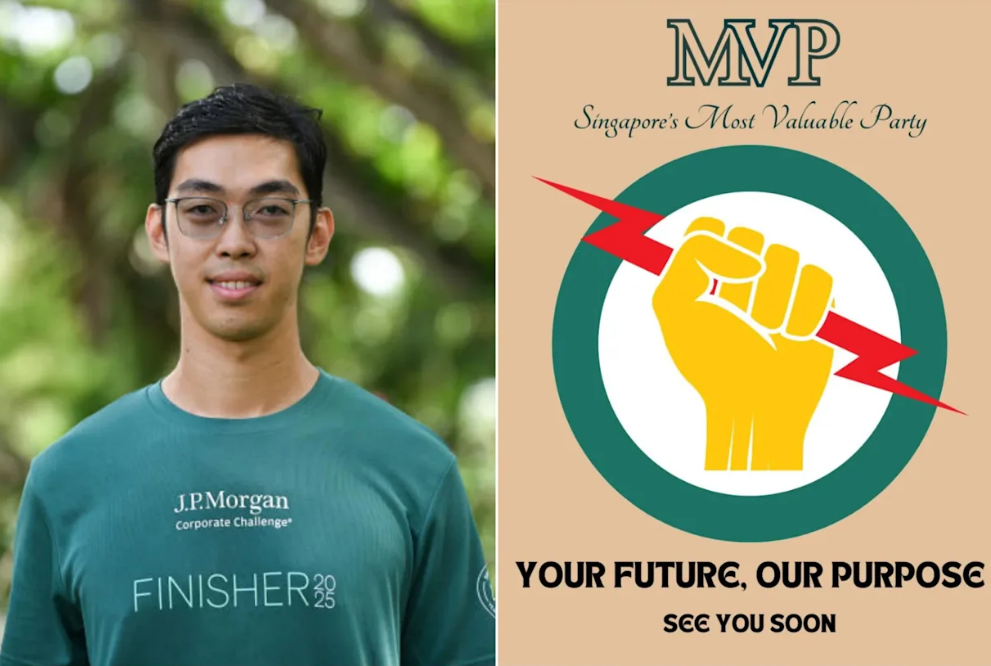
The Most Valuable Party (MVP) is Singapore’s newest political party, having received approval from the authorities about half a year after its application was filed.
This brings the total registered political parties here to 21.
A notice published in the Government Gazette on the evening of Dec 18 said the party was registered under the Registry of Societies on that same day.
The party is founded by restaurant owner Chia Yun Kai, 32, who joined the political fray earlier this year in the lead-up to the May general election.
Mr Chia told The Straits Times that he sent in an application in April. Although the party’s official status took some time to materialise, he said he welcomed the move that would give his party legitimacy.
“The intention all along was to create something official… and now that things are, we welcome more people to join us.”
He had made public his intentions to contest East Coast GRC with his own party, but wound up contesting Pasir Ris-Changi GRC under the Singapore Democratic Alliance (SDA) banner.
The opposition coalition, comprising the SJP and the Singapore Malay National Organisation, garnered 32.34 per cent of the votes against the PAP. Mr Chia had joined as a member of the Singapore Justice Party (SJP).
The new party’s registered address is a unit at Icon Village – a mall in Tanjong Pagar – which houses Mr Chia’s mala eatery.
The Registry of Societies website states that the average processing time under the normal registration process may be two months or more.
The Ministry of Home Affairs, which oversees the registry, confirmed that the application was received on April 11. The Writ of Election was issued days later on April 15, with Nomination Day set for April 23.
Responding to queries from ST on the processing time, it said the registry evaluates every application carefully.
“(It) must satisfy itself that the proposed society will have proper management and governance, will be used for lawful purposes, and will not undermine Singapore’s national security or interests before approving its registration,” said the ministry.
Mr Chia declined to reveal the current number of party members, as well as their identities.
He added that MVP would likely contest as a standalone party in the next election and “put up a good fight wherever we’ll be at”.
Mr Chia is no longer a member of the Singapore Justice Party, confirmed SDA chief Desmond Lim, as he submitted his resignation following the May 4 election “to pursue his political ambitions”.
When told of MVP’s status as an official political party, he said: “Congratulations and best wishes for his political endeavours!”
Forming a society requires at least 10 founding members, and requires paying an application fee of $300 or $400.
Documents required in the application process include the society’s constitution, written in English, as well as any letters of approval or support from relevant stakeholders where necessary.
In the case of a political association, membership must also be restricted to only Singaporean citizens, and such groups cannot be affiliated with any organisation outside of Singapore that is considered contrary to the country’s national security or interest.
Over the years, a number of new political parties have been registered, including Red Dot United and Singapore United Party in 2020 and Progress Singapore Party in 2019.
The three newest parties had all contested in the latest election, albeit in losing efforts.
The Progress Singapore Party burst upon the scene in 2020, doing well enough in West Coast GRC to secure two Non-Constituency MP spots as the best losers that election. They struggled to repeat their showing in 2025 and saw their overall vote share decrease.
In May, Red Dot United fielded the second-highest number of opposition candidates at 15, which was 11 fewer than the Workers’ Party. Within five years of its formation, it went from contesting one constituency – Jurong GRC in 2020 – to four.
The Singapore United Party, formed after the 2020 election, contested only Ang Mo Kio GRC at the recent polls. It garnered just over 10 per cent of the vote and its five candidates lost their election deposits.