
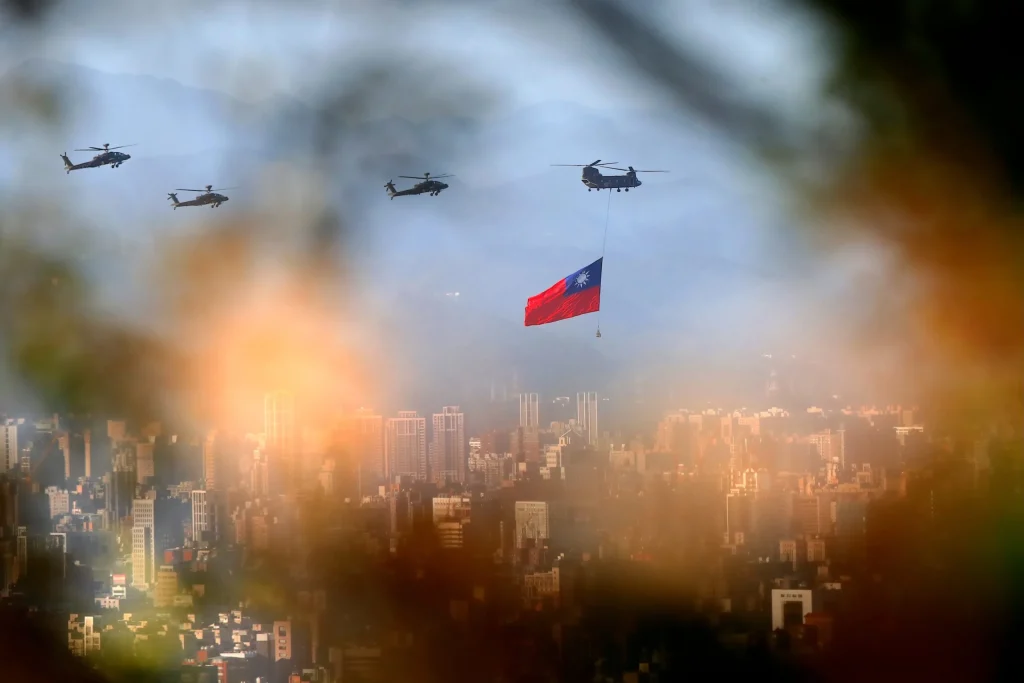
The Financial Times has published two recent articles recently about China, both of which are important pointers to the Taiwan issue and the possibility of Beijing using force to capture the island nation. The US Navy Seal Team 6 which killed Osama is training for Taiwan is one headline, the other relates to Taiwan’s defence minister sending out a warning that China’s military activity over Taiwan is getting intense and may soon make it difficult to spot the actual attack. Both stories indicate a zeroing in on Taiwan, by both the US and China. However, the remarks by the Defence Minister merit greater attention because Xi Jinping and his communist party have intensified their rhetoric and military actions against Taiwan ever since the Nancy Pelosi visit to Taipei. The blurring of lines between peace and war is increasingly making the distinction more difficult and thus when the actual invasion happens, the US may find itself in a bind.
Wellington Koo, Taiwan’s defence minister has therefore, rightly opened up a new thought process on China by warning that the latter’s growing military activity will make it more difficult to spot an actual attack on Taiwan. His point is that Taiwan needed to test its ability to respond to “a potential sudden contingency” from the mainland and added that the reaction time to an emergency needed to much shorter than had been imagined in the past. There is merit in this remark because the fog of war can make it difficult to differentiate between peacetime and wartime. Koo observed that “The scale of [China’s military] activity is getting larger and larger, and so it is harder to discern when they might be shifting from training to a large exercise, and from an exercise to war.”
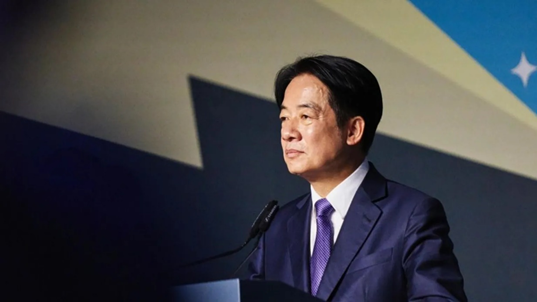
An illustration of this increased activity was observed at the beginning of September (1 September) when Taiwan’s Ministry of National Defence said 18 Chinese military aircraft, eight naval vessels and two official ships were detected operating around Taiwan from 6 am on 1st to 6 am on 2nd September. Defence Minister Koo’s remarks show the challenge that China’s gradual expansion of military moves below the threshold of war poses to Taiwan’s defences. They come as China’s People’s Liberation Army (PLA) has ratcheted up patrols and drills near Taiwan to unprecedented levels since President Lai Ching-te took office in May 2024.
The Communist Party of China (CPC) has denounced Lai, whose Democratic Progressive party refuses to describe Taiwan as part of China, as a “dangerous separatist”. In his inaugural address in May this year, Lai adopted a tougher approach towards China. Three points of note are worth mentioning here. First, he used the word “sovereignty” seven times in his speech. Second, he named China directly with clear reference to the military threat posed by Beijing. Finally, Lai emphasised on “democracy” as the main factor governing Taiwan. This is precisely why the Chinese loath the new Taiwan President.
Perusal of Chinese military activity around Taiwan shows that the island nation has registered a record 2,076 PLA incursions this year alone into its air defence identification zone, a self-declared buffer zone just outside its sovereign airspace. At the start of September, the PLA conducted a large amphibious landing exercise on its south-eastern coast opposite Taiwan. These are part of the regular exercises that China conducts in preparation for an eventual invasion of Taiwan.
The notable thing about China’s strategy has been to also deploy increasing numbers of non-military government ships such as coastguard, marine research and maritime safety vessels around Taiwan. It is believed that these missions gather ocean data for submarine warfare and simulate measures that could be used in a blockade. The Taiwanese Defence Minister noted that the nation’s armed forces would use its observations of PLA behaviour to build scenarios for its own exercises.
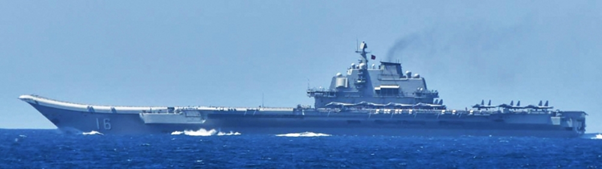
The Defence Minister’s comments on Beijing came soon after a Chinese aircraft carrier group passed through waters near Taiwan’s northern tip. Notably, the Chinese carrier group also sailed through a narrow strait between two of the southernmost islands of Japan, entering the Japanese contiguous zone, for the first time. Taiwan faces a dual challenge in terms of pressure from China and the need to strengthen its defences. With elections in the US round the corner, Taiwan would need to bolster its own security. The US considers any effort to determine Taiwan’s future by non-peaceful means as an issue of grave concern. The Taiwan Relations Act commits Washington to providing Taiwan with defensive weapons and to maintaining US capacity to resist coercion that would jeopardise Taiwan’s security. The real point is that the China threat that is unfolding in front of Taiwan goes beyond the traditional model of the island’s security. The challenge increasingly is going to be to predict a Chinese invasion or associated actions. By muddying the waters around Taiwan, China is creating conditions to enable it to pursue a multi-pronged strategy of economic coercion, blockade and incremental military action. Seeing through the fog of Chinese intentions is thus the first and most important challenge for Taiwan and its allies.
Source: https://www.bbc.com/news/world-asia-67920530
Source: https://www.japantimes.co.jp/news/2024/09/19/japan/china-aircraft-carrier-japan-yonaguni/
Source: https://focustaiwan.tw/politics/202405150022
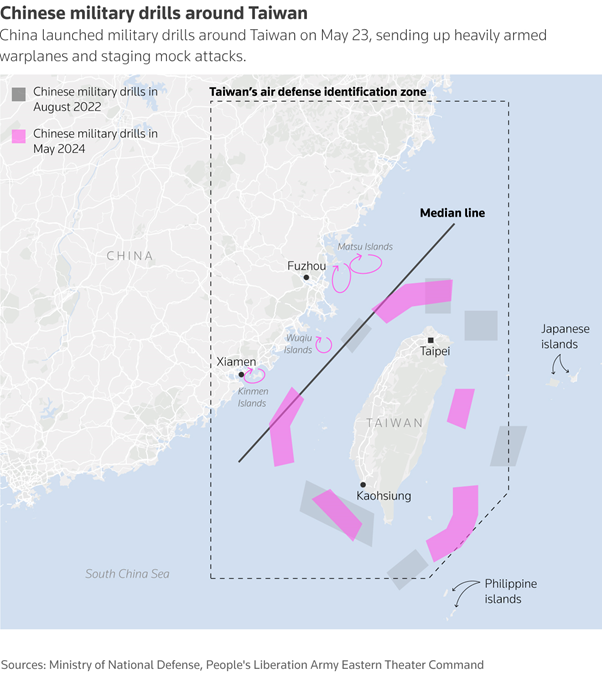
Source: https://www.reuters.com/world/asia-pacific/china-starts-military-drills-around-taiwan-days-after-new-president-takes-office-2024-05-23/