
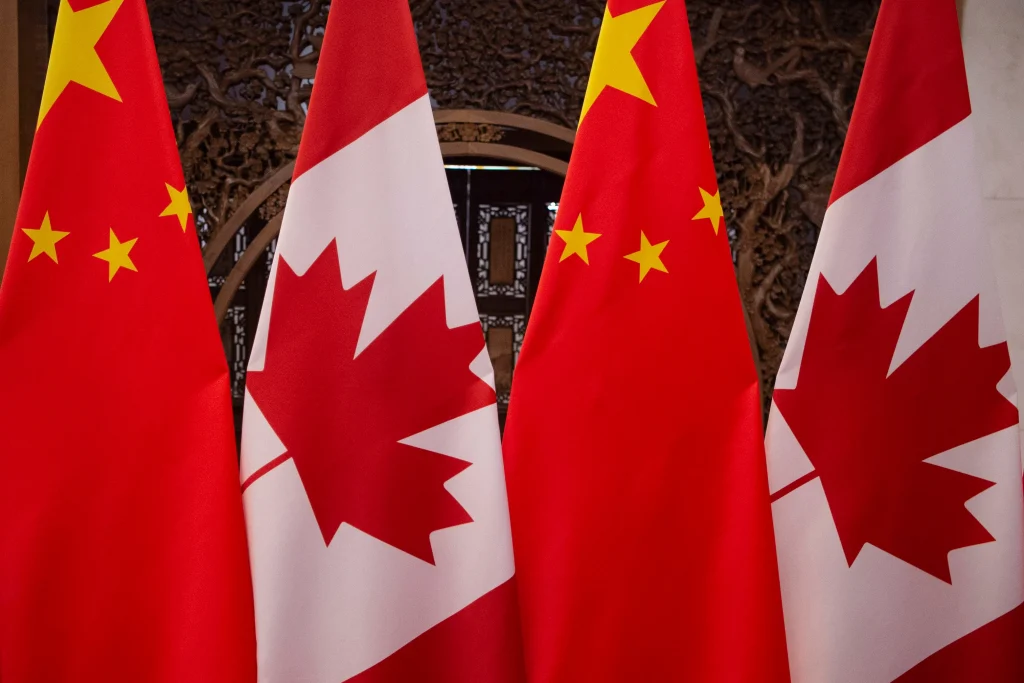
Canada defied China’s warnings and sent its warship through the Taiwan Strait, which now is set to exacerbate the frosty bilateral relations. Diplomatic efforts struggled to thaw chilly bilateral relations. Now the latest Canadian decision to send the warship named HMCS Montreal to join the military exercise in the contested South China Sea is set to escalate military tension between the two major powers. Canada has already taken a clear stand against the forceful annexation of Taiwan and Chinese territorial claims on the Taiwan Strait.
China and Canada have not conducted joint military exercises since 2018 as the Taiwan Strait has become a bone of contention. Notably, the US-led group of nations including Canada have sought the “freedom of navigation” through the Taiwan Strait. Canada’s Indo-Pacific policy maintains that the Taiwan Strait is an international water, which can be used by foreign ships without the consent of China.
Canada has criticised China for showing disregard for the UN rulings on the maritime boundaries in the South China Sea and for the “offensive” expansion of military capabilities in the Indo-Pacific region. “In areas of profound disagreement, we will challenge China, including when it engages in coercive behaviour… or undermines our national security interests and those of partners in the region,” reads the Canadian government’s document on Indo-Pacific strategy.
Earlier, Ottawa was reluctant to add nuclear submarines to its naval fleet. However, with the possibility of the Taiwan conflict snowballing into bigger military battles, the procurement of nuclear submarines is back in discussion. “If you want to be a serious naval power, you have to have capable submarines, especially in response to the Russian and Chinese fleets, which are growing in number and capability, growing in terms of the technology,” said Vincent Rigby, a former national security to Canadian Prime Minister Justin Trudeau.
There have been increased naval activities by Canada in the Indo-Pacific amid rising tension in the Taiwan Strait. Canada opposes the unilateral efforts by Beijing to alter the status quo across the Taiwan Strait and forceful annexation of Taiwan. This makes Canada vulnerable to retaliation from China. Beijing has already warned Canada of the risky consequences of its Indo-Pacific policy.
Canada had in February planned to send HMCS Montreal to the Taiwan Strait even as China said it would be tantamount to a violation of the One China policy, supported by Ottawa. “The Canadian Armed Forces will continue to play an active role upholding the rule-of-law-based international order and promoting stability and prosperity in the Indo-Pacific,” said Captain Véronique Sabourin.
Diplomats of both countries have met several times to mend their differences. However, the Taiwan Strait issue remained unresolved. There are growing concerns in Canada that peace with China is not possible. “The hostile intentions and actions of our adversaries show that they consider themselves to be at war with the West. We must accept this reality and respond accordingly,” said the ex-Chief of the Defence Staff Gen. Wayne Eyre.
All this has led Canada to focus on strengthening its military capabilities, including the addition of new submarines. “Canada will increase our military engagement and intelligence capacity as a means of mitigating coercive behaviour and threats to regional security,” reads the document on Indo-Pacific strategy” Canada now has decided to increase military cooperation with Australia which has been at loggerheads with China since the beginning of Covid -pandemic.
Now China has begun patrol in areas where joint military drill was held by the US, Philippines, Canada and Australia. It even warned Canada after the HMCS Montreal sailed through the Taiwan Strait. “We warn Canada that it should abide by the One-China Principle, be cautious in its words and deeds on the Taiwan issue,” Chinese defence ministry spokesperson Zhang Xiaogang said.
Experts believe there will be no improvement in Sino-Canadian relations, especially, after Canada has decided to increase its naval presence in the Indo-Pacific region. “Canada has the worst relationship with China of any G7 nation and has a worse relationship with China than any of the United States’ Asian allies,” said Jeremy Paltiel, professor of politics at Ottawa-based Carleton University.
END.