
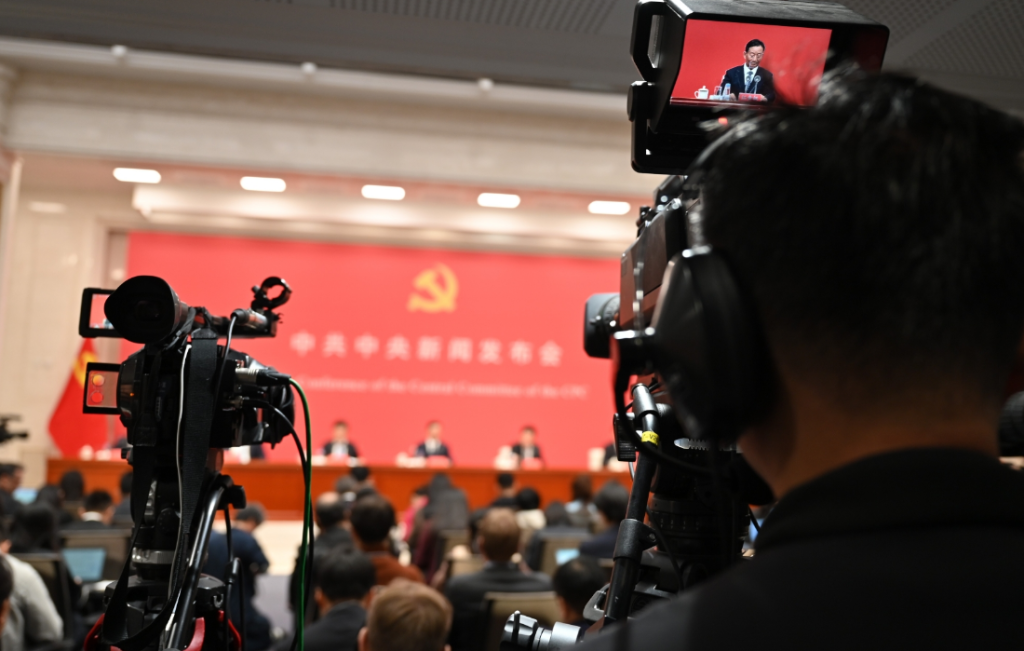
hina’s recently concluded Fourth Plenum juxtaposed extensive purges and personnel turnover with policy continuity, as we discussed prior to the plenum. The plenum lasted from October 20 to October 23, concluding with the Chinese Communist Party leadership purging 10 members of the Central Committee, which, before the plenum, comprised the party’s top 205 officials, including 42 members of the military high command. On the policy side, this plenum was especially consequential because the party leadership provided its recommendations for the 15th Five-Year Plan (FYP), which will guide China’s development from 2026-2030. The plenum’s recommendations will feed into the final draft of the FYP, which will be formally approved by China’s National People’s Congress, its titular legislature, during its annual meeting in the first week of March. In the meantime, observers should expect additional signals about Beijing’s economic priorities for the coming year at the annual Central Economic Work Conference, which typically occurs in early December.
Policy: Assessing the party’s recommendations for the 15th Five-Year Plan (2026-2030)
Continuity. The plenum produced a series of major documents pertaining to the next FYP, including the plenum communique, the Central Committee’s recommendations, and Xi Jinping’s explanation, as well as a series of remarks by other top officials. The plenum communique signaled some subtle shifts in policy priorities, but the main theme was one of continuity. For example, in the last FYP, the party leadership made technological self-reliance the first priority, while the second priority was building up the modern industrial system—including its advanced manufacturing and high technology sectors. This year’s recommendations for the next FYP flipped that order.
Xi’s focus on continuity makes sense: he is now well into his third term and can see tangible progress on the techno-industrial ambitions that have animated his economic agenda. While China’s economy still suffers from pronounced weaknesses—most notably, the real estate sector’s continuing contraction and deflation driven by intense domestic competition that has cut into companies’ profits—Xi likely judges that these are problems to be managed rather than enduring impediments to China’s economic development.
Confidence. While the plenum introduced little new substance, the tone of its authoritative documents was both more confident and more urgent than those released before the last FYP in 2020. This may reflect Beijing’s assessment that its efforts to fortify China against U.S. tariffs and identify points of leverage over Washington have been surprisingly effective during this second trade war. Xi and other senior officials also expressed greater confidence about China’s ability to shape the international environment in China’s favor, raising “achieving win-win cooperation” with the world from the ninth to the seventh priority. The Central Committee’s recommendations assert that “a profound shift is taking place in the international balance of power” and cites accelerating “breakthroughs … in the new round of technological revolution and industrial transformation” as creating “positive factors” for China to act more proactively abroad.
This confidence is underpinned by an acknowledgment that Chinese firms are producing globally competitive artificial intelligence models, dominating renewable energy markets, seizing global market share in electric vehicles, and building semiconductor production capacity, particularly in legacy chips. While the party leadership acknowledged the challenges facing China, it also exhorted cadres to approach them with “courage.” Notably, the plenum’s recommendations document lauded Beijing’s development over the past five years as “extraordinary and remarkable,” a marked upgrade over the 14th FYP’s description of the 13th FYP period as “decisive” and remaining “core to its original aspiration.” The slightly lower priority given to self-reliance by the 15th FYP suggests that the party feels it has made significant progress in insulating supply chains and advancing its techno-industrial base throughout the 14th FYP period—which was drafted in a milieu, as well as characterized by zero-COVID lockdowns, a bloated property sector, and an unpredictable trade war—and that it will continue to do so.
Urgency. The plenum documents conveyed a greater sense of urgency to accomplish the party’s goals. Xi himself noted in his explanation that the next five years will be critical for “basically achieving” socialist modernization by 2035. As China analyst Andrew Polk highlighted at a recent Brookings event focused on the Fourth Plenum, that sense of urgency likely reflects Beijing’s need to complete China’s difficult economic transition before demographic decline further hinders economic growth. That transition entails an ongoing and painful shift from a growth model centered on investment, labor, and real estate to one built on China’s deepening techno-industrial prowess. Polk has pointed out that if the 15th FYP’s ambitions are realized, China will command an even greater share of global manufacturing, amplifying the impact of the current trade imbalances resulting from China’s overcapacity. China already accounted for 29% of global manufacturing in 2023, and further gains could have significant global ramifications.
Beijing’s decision to double down on its current model underscores how ineffectual U.S. tariffs and European trade measures have been in prompting Beijing to reconsider its economic policy. In fact, the potency of these U.S. and allied tools may only be diminishing over time. For instance, even after the Trump administration’s imposition of tariffs on China this year, China’s net exports actually increased in the subsequent months before unexpectedly contracting last month.
Consumption? The plenum communique notably diverged from last year’s Central Economic Work Conference, which proclaimed expanding domestic demand as the party’s top economic priority—a prioritization that has been echoed over the subsequent year in authoritative party and state pronouncements. Instead, consumption is now identified as the fifth priority—exactly the same spot it occupied in the previous FYP. Xi remains loath to expand China’s welfare commitments at a time when China’s demographic decline will already squeeze its finances, especially since China currently lacks the fiscal space to roll out additional stimulus measures that do more than stabilize China’s macroeconomy. As economic analyst Gerard DiPippo has pointed out, the leadership believes that “consumption is an outcome to be achieved through improving the productive side of the economy.”
Personnel: Purges confirmed, with portents of more to come
The plenum’s most striking and dramatic developments came on the personnel side. The current Central Committee began its term in 2022 with 205 full members and 171 alternates, but only 168 full members and 147 alternates attended last month’s plenum—the lowest turnout in the post-Mao era, according to China scholar Neil Thomas. Prior to the Fourth Plenum, three full Central Committee members had been purged, and three alternates were elevated to full members. At the Fourth Plenum, the leadership purged 10 full Central Committee members and four alternates, while one full member passed away last December.